


Practice
Statement & Bodies of Work
Outright Mental is a practice built on a single discipline: presence over avoidance. The work begins where cleverness ends — at the point avoidance stops working and the only honest move left is to look directly at what is in front of you and proceed anyway.
Across twenty-five years and every medium the studio has touched — film, illustration, music, software, physical games — that discipline is the through-line. Each piece is treated as a complete expression, made with full attention and taken as far as it will go. Small is not a phase; small is the method.
What follows are four bodies of work in which the practice is most legible: an ownership model published as arithmetic, a mark that turns a pirate flag inward, a game forged in public on a hand-built table, and software that refuses to watch the people who use it. Each is offered as work, and documented as work.
The Ledger
2015–present · Social practice — a published ownership ledger · Self-published in full, San Francisco
Ownership, at most studios, is a negotiation conducted in private and settled in a document only a lawyer can read. The Ledger is the refusal of that. One hour of human time is one point; cash compensation buys down the point rate; ownership is your points divided by the pool — and the whole of it is published, openly, for anyone to audit with a calculator.
The studio runs this on its own work first. The XJ founders pool is opened in public: 14,772 hours, 13,012 points, $117,825 in cash paid, the founder’s 76.04% earned at the identical rate as every line beneath it. A decade of contributions, ten schedule lines, not one equity dispute — every figure hours times a rate you can check. Publishing your own cap table as proof that ownership can be arithmetic is the piece itself: institutional critique made out of the institution’s own books.
The practice is ongoing, and it is performed. Each time the ledger changes it ships with a short public note. When the model is handed to a new team, the charter is co-signed on camera — the arithmetic entering the world as ceremony rather than paperwork.
Documentation — the published founders pool · the model in full · the machine-readable ledger · the co-signing ceremony
Mental Roger
2013 · Vector emblem; cast in pewter, 2017 · Outright Mental

Mental Roger is the studio’s flag. It reads at a glance as an antiestablishment banner — a Jolly Roger — but the defiance is turned inward. The figure is cutting open the top of its own skull. It is not violence; it is exposure: opening the mind rather than armoring it.
Two uncrossed blades hold the balance the practice is named for — precision and surrender at once, neither one winning. It is consciousness inside matter, a reminder that you are a ghost piloting a meat puppet and that everything, including fear, is temporary. The mark flies as a warning and an invitation at the same time: look directly, proceed anyway.
Documentation — the iconography essay · cast in pewter as a lapel pin, 2017
The Coffee Table
2024–present · Hand-built dual-screen arcade table; live weekly play · Noisebridge, San Francisco · shown at Maker Faire Bay Area, 2025
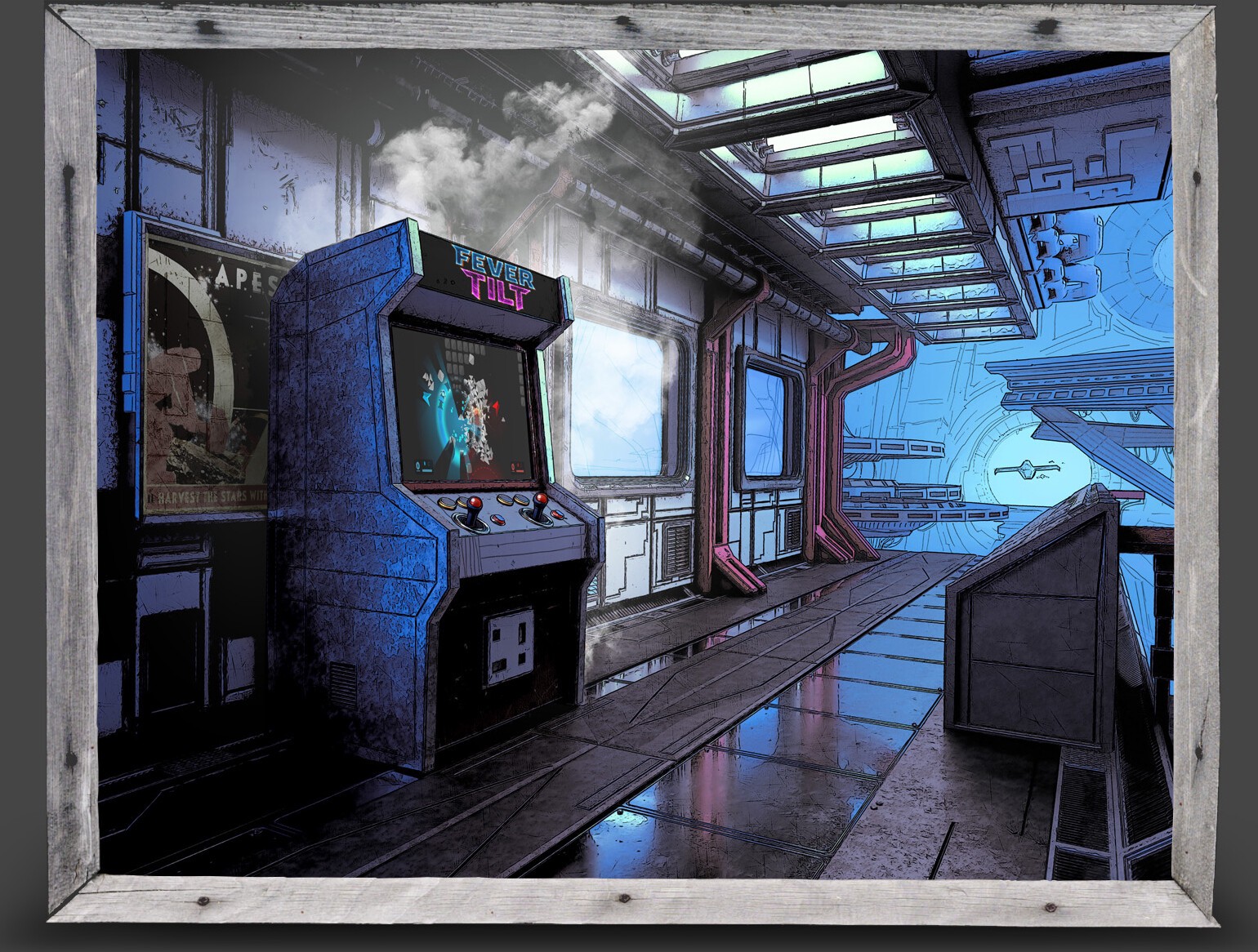
The 1v1 Coffee Table is a custom dual-screen arcade station built by hand at Noisebridge, the San Francisco hackerspace. It is a real object with a real grain, designed for two people standing at opposite ends, face to face — on screen the far player’s name renders upside-down, because the table never pretends the two of you aren’t there.
On that table a sport was forged. Fever Tilt — a ruthless zero-gravity arena game — was not designed in private and then tested; it was built in public, beaten into shape across weekly sessions at the open Gamebridge meetup, and shown to strangers at Maker Faire Bay Area in 2025. The weekly play is the performance, and it is still happening: every Wednesday, anyone can walk in, put a name on the board, and take the far end.
That is the material culture of the practice — a game you can only fully read by standing at the table, and a competition that exists only because real people keep showing up to it.
Documentation — the flagship’s page · the Coffee Table at Noisebridge · the A.P.E.S. universe it lives in
Local-first works
2026 · Local-first software (new media) · Outright Mental
Two 2026 works share one refusal: they will not watch the person using them. Conversation Simulator is a practice environment for the conversations that decide careers and friendships — the raise, the diagnosis, the apology — and it runs entirely on your own machine. No account, no cloud, no telemetry. The claim is not asserted; it is falsifiable. One command runs a full conversation and fails loudly if any part of the software so much as reaches for the network. Trust you cannot verify is just branding.
Read The Room applies the same discipline to the tenderest data a person holds — the 1:47 a.m. rereading of a thread that went quiet — and answers it with a structured report instead of a system engineered to keep you talking. Both works are presence over avoidance shipped as software: they end the loop by naming the pattern and handing back one concrete move, and they do it without building the surveillance in.
Local-first is the aesthetic position here, not only the architecture: to make a tool that keeps its promise in the one place a promise can be checked — the user’s own disk, with no server left to trust.
Documentation — Conversation Simulator · Read The Room · the source, Apache-2.0
Look directly. Proceed anyway. The thesis in full is the manifesto.