

A.P.E.S.
Apes Perpetual Expansion & Selection, 2024–2026
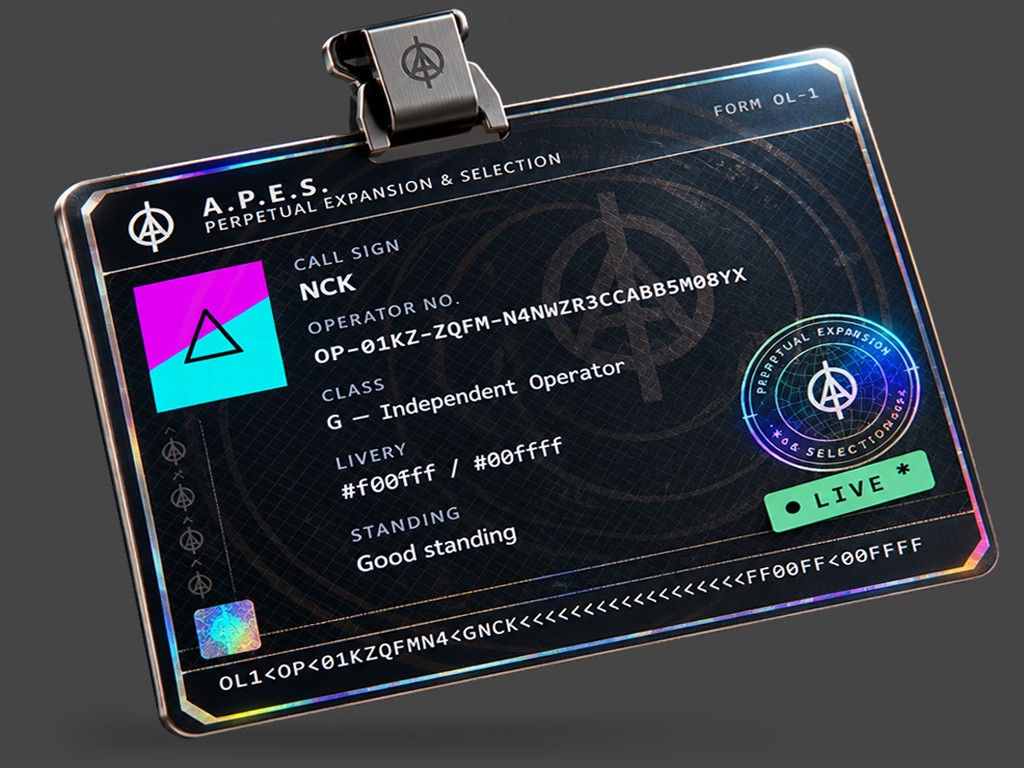
A.P.E.S. is a license. Form OL-1: a call sign, two colors and a rig, issued in about thirty seconds by the Apes Perpetual Expansion & Selection corporation, the megacorp that owns the sky Star Harvester and Fever Tilt are set in. It is also a real sign-in, at apescorporation.com, built to be your player card in every game in that sky.
Set up your license. A license is issued, not purchased. There is no password, so there is nothing to steal.
- Role
- World, writing, design & engineering
- Target
- One fictional corporation that is also a real sign-in: a license that is the player's card in every game set in its sky and gives no game your email address, issued by a company that never admits it is in the games business
- Constraints
- A real identity server first: OpenID Connect and OAuth 2.1, no passwords, and a plain-words page that says who runs it · the corporation never names a game that connects to it; the games name it · wherever a person has to act, recover or consent, the plain words come first and the fiction steps aside · any two colors a player picks must stay legible on a game's near-black, a tournament portal's gray and a white printout · a printed or exported license must never pass for a live one
- Force fielded
- Nick Charney Kaye: world, writing, design and engineering
- Time-to-dispatch
- The corporation on Star Harvester's title art since 2024; the identity server begun in August 2026; apescorporation.com and its public face live in October 2026, and the license issued there since
- Result
- Form OL-1, issued at apescorporation.com: a call sign, two colors and a rig in about thirty seconds, with a code to your email or phone and no password, sealed live for its holder, and the only thing a game receives when you sign in
- Principal
- Outright Mental (original IP)
Signing in is the first scene
Every game asks you to sign in, and nobody remembers doing it. A.P.E.S. makes it the opening scene. You are not creating an account. You are applying to the Office of Selection, and half a minute later you hold a license with your call sign on it, an Operator No. that will never be reissued, and Class G, because there is one class.
One ordinary act, and you are standing inside the fiction. Before a single game has loaded you are an Independent Operator on the register of a corporation that has a position on monopoly, a notice about looking directly at the harvest, and a clause in its fine print for the arcade cabinet on the walkway. You asked for a login. You were issued a place on a register, and notice 26-41 has already explained that you were on it.
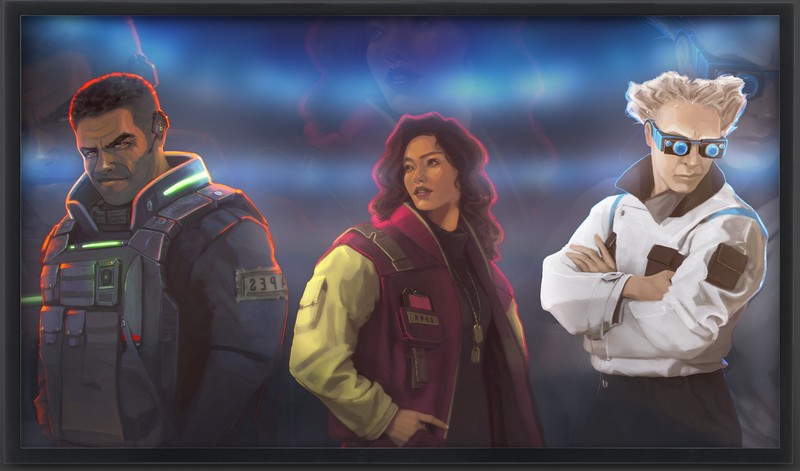
The license is the door, and the rest of this sky is behind it: the Corporation’s own paperwork, two games, the poster on the corridor wall and the faces in its personnel files.
What is on it
- Call sign. Two to twenty characters, printed as you spelled it, and unique across the register. Two call signs that look alike are one call sign: case, spacing, punctuation, accents and lookalike letters from other alphabets all fold away, so once someone holds
N0VAnobody can register aNovathat reads as theirs on the bracket that decides a tournament. - Livery. Two colors, hull and trim. The Corporation prints in one ink. The livery is the only colour it issues, and it is the operator’s.
- Rig. A line drawing of the equipment you are rated on. The Corporation owns the rig. The drawing is the operator’s.
- Operator No. Issued once, never reissued, and printed on the license as an anti-counterfeiting measure, which it is: the number is random, so nobody can walk the register by counting.
- Class. G. There is one class.
- Standing. Good standing, under review or withheld: a status of the record, never of the person.
Along the foot runs a machine-readable line, like a passport’s, with the form, the number, the class, the call sign and the livery.
Any two colors
Every color is issuable. The license is drawn on three surfaces (a game’s near-black, a tournament portal’s gray and a white printout), and a color too close to any of them is set on a small black or white plate there, so the mark always stays legible. The pair has to be told apart as well, by brightness or by a difference that survives a color-blindness simulation, and when it can’t be, the editor says something true and specific, such as these look identical to a red-green colorblind viewer, instead of a warning nobody acts on.
The seal
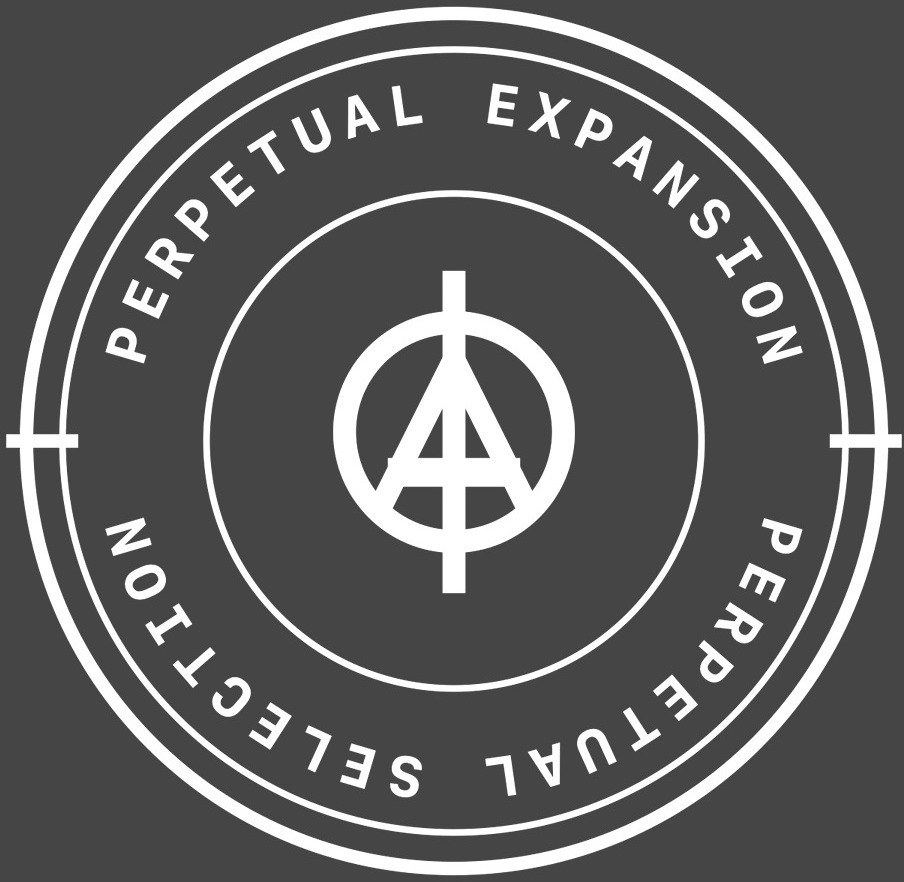
The Company Seal is pressed on every license, and again behind it as a watermark too large for any crop to lose. On the card the Corporation shows its holder, the seal carries a green LIVE tag. On the one card it publishes, the tag reads EXAMPLE, and a printed card loses its tag altogether, because paper is not live. The note under every card says why: any license without a live seal is just a souvenir. The Corporation’s notice 26-33 puts it more coldly: Printed and exported copies are marked SPECIMEN and are not accepted at any counter.
The card is the login
Underneath the paperwork is a real identity server, built on OpenID Connect and OAuth 2.1. You clock in with a code sent to your email or phone, and that is all: no password exists to be stolen.
When a game asks for you, you see a Work Order that says who is asking, what they may do (read your call sign, colors and rig; report your results) and what they may never do (see your email address or phone number, alter your license, present you anywhere else). You approve it, and the game receives the license and nothing else. At a cabinet across a bar, the screen shows eight letters and you approve them on your own phone. The code is drawn from twenty consonants, with no vowels and no digits, so it can never spell a word and never be misread from across the room. Then the line that sums up the whole product:
Your license stays here.
In the fiction it is quietly ominous: you leave, the license remains, the license was never yours. As engineering, it is the most accurate one-sentence description of why signing in this way is safer than handing a game your password. Every line on the site tries to be both at once.
That is why the license is built to be the player card for every game in this sky: the same call sign on the tournament bracket and in the asteroid field, the same two colors in the arena and on the rented ship, and no game holding anything it could leak. Fever Tilt is on the register already: its cabinets and its tournament portal are both entered as concessions, under CONTRACT 4085600, which is its Steam app number, because a contract number in this universe is a number and not a decoration. Star Harvester’s ships are rented from the same company. As each game comes to the counter, the license will be waiting at it.
Every operator. One register.
A.P.E.S. began on Terra as a placement bureau for hazardous work, and its founding asset was a list. When the orbital claims were awarded, they went not to the richest bidder but to the only organization that could name a hundred thousand people willing to go. Expansion came second. Selection is what the Corporation is.
So it does not want your labor; labor is abundant. It wants your entry on the register. Its front page says so in one line: The register of every operator on the near-Terran claims. Extraction is downstream. After the Consolidation (the word acquisition appears nowhere in the record) came the Class G reform, which, in the Corporation’s own history, abolished not the workers but the category. Everyone became an Independent Operator, Class G. Wages became yield share.
It is a future that shot for Star Trek and landed in a gig economy, and the Corporation will explain it to you, patiently, for as long as you like.
In its own words
The Corporation publishes notices, and it issues position statements on questions it has evidently been asked and evidently considers settled. A selection, word for word:
26-24. Yield share is not a wage. Operators are referred to the Conditions of use.
26-19. Operators are not employees. The Corporation has none. It has a register.
26-07. Attrition is priced in.
26-05. Do not look directly at the harvest.
26-01. Forty-one thousand decks. One company.
On the question of ownership. Operators ask whether they may own their rig. They may not. Ownership is a liability, and the Corporation has assumed it on the operator's behalf, at no charge beyond the rental, the fees, the deposit and the damage schedule.
On the question of Tulgaska. The star demolition at Tulgaska, in cycle 2579, was conducted by a private demolition contractor under no license of the Corporation's. The Corporation does not demolish stars. It harvests them, and a harvested star remains available for harvest.
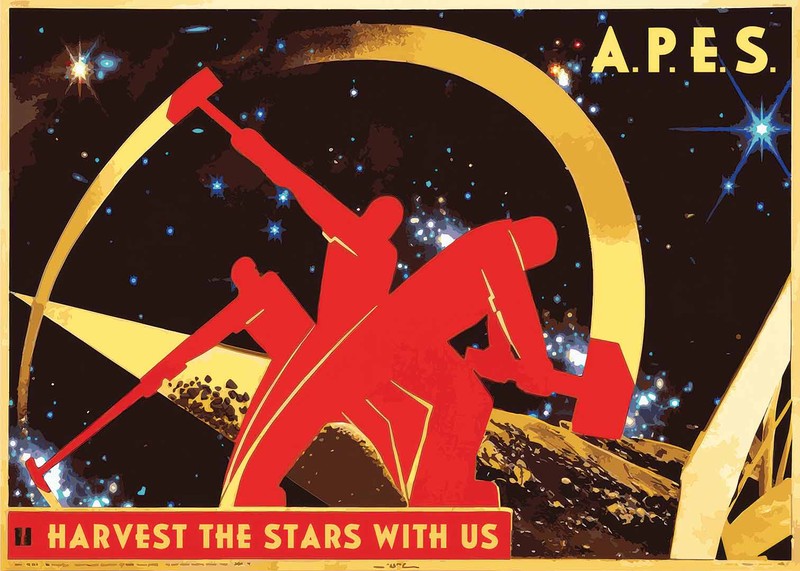
The Corporation never says we. Its one exception is the line on the poster: HARVEST THE STARS WITH US!, the only exclamation mark it allows itself. The distance between the poster and the paperwork is the whole tone of the property, and nothing on its site closes it with a wink.
Two games, one corporation
Star Harvester is the job. You sign on as an A.P.E.S. Star Harvester, rent a ship (you may not own one; see the statement on ownership), and fly it into an asteroid field to strike it rich. The A.P.E.S. code forbids direct harm to a competing harvester, but accidents happen, and the paperwork is where the money is: taxes, fees, commissions and extortion. Hustle & Treachery is what the Corporation’s rules look like from the cockpit. Star Harvester →
Fever Tilt is the break room. It is the arcade machine on the station walkway, smoking from overuse, under the poster. And in the Corporation’s own paperwork it does not exist at all, except as a single clause, in fine print, at the bottom of the Conditions of use:
9(c) Simulation and recreational access. Where a concession operates a conditioning simulator for public or recreational access, a licensed operator may present their license for entry. Such access is recreational, unremunerated, and does not constitute assignment to a claim. Yield recorded under simulation is notional. A.P.E.S. does not warrant that participation in simulated conditioning improves selection outcomes, and makes no representation as to enjoyment.
The whole video game is a footnote in a mining company’s terms. The Conditions even translate its rules into the Corporation’s prose: own goals become throughput delivered to any goal is credited to the operator delivering it, without regard to the goal’s assignment, and the laser becomes thermal moderation of a peer unit, a permitted denial technique within the conditioning volume. Fever Tilt →
Look at the logo
The mark is a stake driven through a circle, with an A on the stake: a claim, staked. Beside it, A.P.E.S. in heavy capitals and PERPETUAL EXPANSION & SELECTION spaced out underneath, in one ink on the Corporation’s paper. The games are neon on black; the Corporation is a document. It is the calmest thing in this sky, and that is what makes it unsettling.
The poster is the opposite: the one loud thing the Corporation owns, a constructivist recruitment sheet, operators swinging picks into a star under a gold arc. The pick is the joke. It shouts so the paperwork never has to, and it has a page of its own: A.P.E.S. Propaganda.
Where the joke stops
A.P.E.S. is absurd about itself and never cruel to you. Its site has one page written entirely in the reader’s own words, What is this?, and it answers the question a stranger holding a phone is asking:
The service is real. A.P.E.S. is a fictional corporation, and the service is operated by Outright Mental Inc., San Francisco. Everything on this site that sounds like a mining company is the fiction; everything that asks you to do something is the service, and it is written plainly.
So every field label, every error, every page about losing access and every consent screen is plain English. A license is issued and a game is a concession, but the buttons say Clock in, Set up your license and Continue, because a button cannot be a joke. The Corporation’s euphemisms point only at the Corporation, never at the person reading.
And it names no game that connects to it: read every page of apescorporation.com and you will not find Star Harvester or Fever Tilt, because a real sign-in names nothing, and a corporation that named its games would be a feature of them rather than a company you sign up for. The games name A.P.E.S. A.P.E.S. names no one.
Release log
16 August 2025: Blockbusters, the cabinet that became Fever Tilt. The journal entry.
August 2026: the identity server, and the rule that the Corporation names no game that connects to it.
October 2026: apescorporation.com opens its public face: the poster, the figures, the notices, the position statements, and the license, issued to anyone who asks.
Next: the games come to the counter.
Our manifesto commits the studio to properties that can stand on their own. A.P.E.S. is the strictest test of that we have set ourselves: a world that does not appear in a single game’s menu, yet signs you in, carries your name between games, and has a position on monopoly.
Box score
- Is: a license, the megacorp that issues it, and a real sign-in at apescorporation.com
- The license: Form OL-1: a call sign, two colors, a rig, an Operator No., Class G and a standing, sealed live for its holder
- Signing in: a code to your email or phone, never a password; at a cabinet, an eight-letter code you approve on your phone
- A game receives: the license and nothing else; never your email address or phone number
- On the register: Fever Tilt’s cabinets and tournament portal, under CONTRACT 4085600
- The rule: A.P.E.S. names no game; the games name A.P.E.S.
- Proof: apescorporation.com · the license · set up yours · what a game receives · the position statements · the notices · the Bureau Charter
Perpetual expansion. Perpetual selection.