

Umlauts
The Vowel Wheel That Started Umlaut Hero, 2026
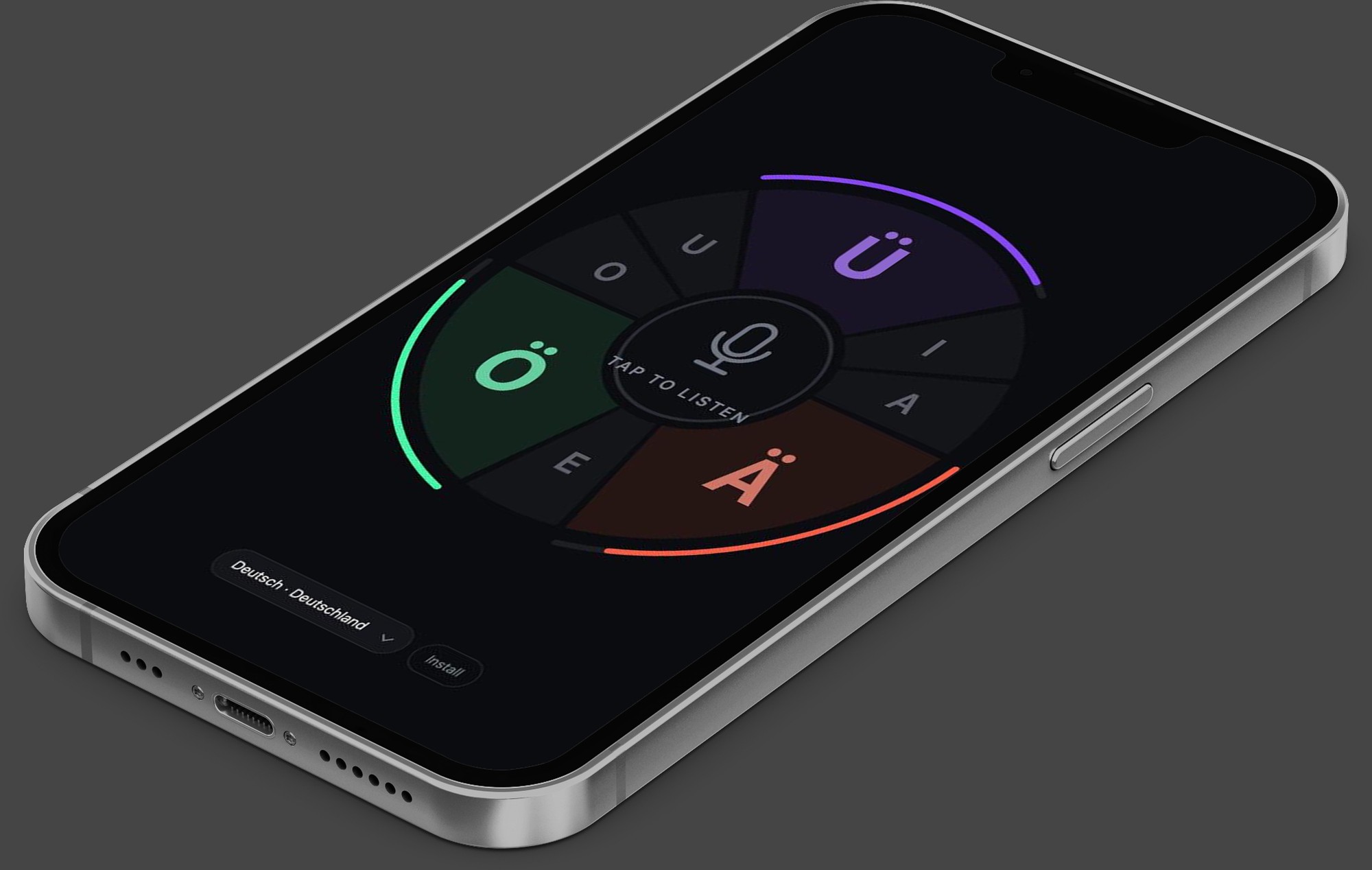
Umlauts is one screen and one wheel. Tap Ä, Ö or Ü to hear it, then say it yourself and watch where your vowel lands.
- Role
- Voice analysis & engineering
- Target
- A wheel that teaches how Ä, Ö and Ü should sound by listening to a learner say them
- Constraints
- Built in a day at a hackathon · runs in the browser, on the device, with no server and no dependencies · installable, and offline once visited
- Force fielded
- Nick Charney Kaye, after he started learning to speak German
- Time-to-dispatch
- Built in a day, 11 November 2026; it inspired Umlaut Hero, whose 1.0 shipped on 17 November 2026
- Result
- A live vowel wheel at umlauts.outright.io, and the instrument Umlaut Hero is built on
- Principal
- Outright Mental (original IP)
Where Umlaut Hero came from
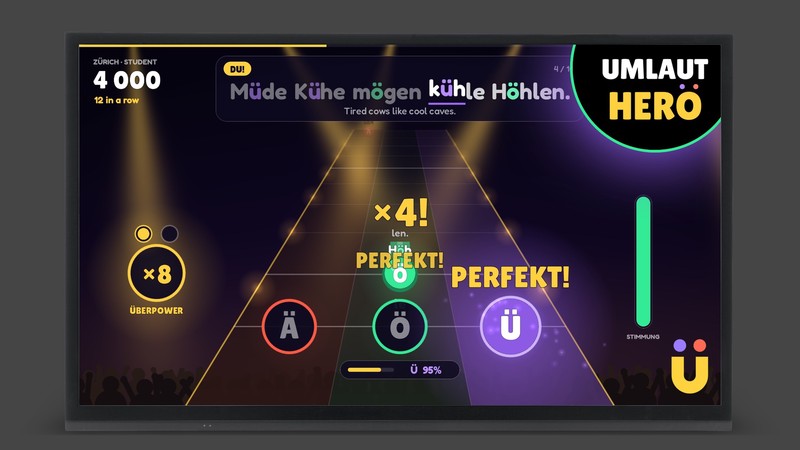
Nick Charney Kaye started learning to speak German and got very excited about it. Umlauts is the hackathon experiment that excitement produced, built in a day in November 2026: a wheel of umlauts to help a learner hear how they should sound, and see how close their own voice comes.
It is what inspired Umlaut Hero. The game reuses this wheel’s instrument, the formant analyser that turns a microphone into how close a vowel is to Ä, Ö and Ü, and builds a band, a crowd and a six-gig tour around it.
How it plays
- The wheel is a pie of vowels. The three umlaut slices are wide; the plain vowels sit between them as thin wedges, each umlaut between the two vowels it is made of: Ä between A and E, Ö between E and O, Ü between U and I.
- Tap a slice and a small formant synthesiser sings the vowel as a held note: the bare sound the microphone scores you against. Nothing is read aloud, because a letter’s name is a different sound in most languages.
- Tap the hub to turn the microphone on. While you speak, a pointer swings from the centre to wherever your vowel sits on the wheel, like a clock hand. Slide from ah toward eh and the hand drifts into Ä, which starts to glow.
- From 86% a slice is nailed: it glows, coins spout out of it, a chime sounds, and the arc on the rim remembers your best.
- The menu switches language or dialect. German as spoken in Germany is the default; Austria and Switzerland move the Ä the way those standards do, and Swedish, Finnish, Hungarian, Turkish and Estonian bring rings of their own.
How it listens
Everything runs in the browser, on the device, with no server and no dependencies. Each animation frame takes the newest forty milliseconds of audio, fits a twelfth-order all-pole model with Burg’s method, and reads the vocal tract’s resonances (F1, F2 and F3) off the roots of that polynomial. The distance from those to each reference vowel is measured in Bark, the perceptual frequency scale, and turned into a score.
It installs as an app on a phone and works offline once it has been visited.
Proof: umlauts.outright.io, free in any browser · Umlaut Hero, the game it became