


Star Harvester
Hustle & Treachery, 2026
Hustle & Treachery. Rent a ship from the A.P.E.S.™ megacorp, blast into the asteroid fields and strike it rich harvesting the stars, by any means necessary. Star Harvester is a loud, ruthless action-adventure of hustle, treachery and conquest.
Play it free in your browser, or get it on the App Store for iPhone, iPad and Mac. Steam is next.
- Role
- Game design, engineering & art direction
- Target
- A loud, ruthless action-adventure about striking it rich harvesting the stars, where the rules themselves are one more resource to work, and every angle has a price on it
- Constraints
- Developed in the open on Discord · one Flutter codebase for the browser, phones, tablets and desktops · an asymmetrical design, which means the usual balance escape hatch is off the table: scarcity, time pressure and uneven starts are the game, not bugs to smooth away · a trailer nobody films, captures or edits by hand
- Force fielded
- Nick Charney Kaye: game design, engineering and art direction; the champions painted by Storam
- Time-to-dispatch
- First released 29 December 2024 on the web, Android, iOS and macOS; rebuilt into the game it is now by November 2026, when one release began shipping it to every store at once
- Result
- Star Harvester: free in any browser at zero.starharvester.com and on the App Store for iPhone, iPad and Mac, sold from starharvester.com, with a 34-second trailer the game records of itself for every release
- Principal
- Outright Mental (original IP)
Rent a ship
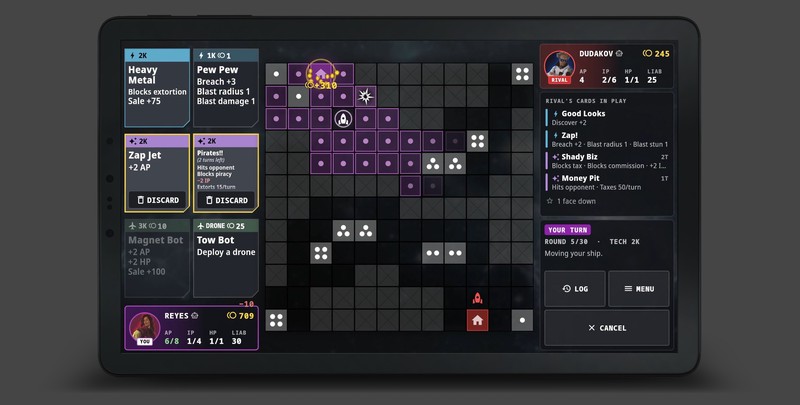
The Apes Perpetual Expansion & Selection corporation owns near-Terran mining, and it does not sell ships. It rents them. To get your share, you sign on as an A.P.E.S. Star Harvester and fly a rented rig into a 12 × 12 asteroid field where every resource is scattered at random, favoring no one.
Discover the valuable rocks, breach them, clear the debris, and send your drones to haul the fortune home before your rival beats you to it. Three champions sign on (Van Sacke the commander, Reyes the freelance explorer, Dudakov the scientist), each with their own stats and their own deck, and the rival across the field flies one of the others.
Accidents happen
The A.P.E.S. code forbids direct harm to a competing harvester. But accidents happen, and if they’re in the way, that’s on them. Blast a rival’s ship or drone and half the damages land on your liability; it might pay off.
The rest of the paperwork is just as negotiable: taxes, fees, commissions, extortion, and pirates who raid any ship that ends its turn away from home. Dodge the costs, trick your rival into the moves that cost them more, cut the deal that blocks them out. Two ways to win: reach 1,000 coin, or build up 300 liability. Thirty rounds at most, then the higher score takes it.
How a match plays, turn by turn, is a page of its own: Star Harvester Gameplay.
The game plays itself
Nobody filmed the trailer at the top of this page. The game recorded it, one frame at a time, by playing a whole match against itself.
It opens on the start screen as a new player sees it, then starts a game the way a player would: New Game, a champion (Reyes), Start Game. From there the computer flies both sides, in the game’s own AI battle mode, pausing just long enough between moves to follow. Each chapter opens on a line of the rules, laid over the dimmed field, and then the match shows you what the line means.
RUNTIME 0:34 · 1920 × 1080 · 30 FPS · H.264
0:00 THE START SCREEN, AS A NEW PLAYER SEES IT
0:04 RENT A SHIP. HARVEST THE FIELD.
0:13 ACCIDENTS HAPPEN.
0:22 TWO WAYS TO WIN. (ON THE GAME'S OWN RESULTS)
0:28 END CARD: HUSTLE & TREACHERY · THE STORES
CAMERA: NONE. NARRATION: NONE. EDITOR: THE TEST HARNESS.
Every frame exact. The trailer is a test. Flutter’s test harness owns the clock, so every frame is exactly one thirtieth of a second after the last, on a laptop or a build server, and the board is seeded, so the same rocks land in the same places every time. Each frame is drawn at twice the game’s layout size and piped straight into ffmpeg. Nothing is screen-captured, so nothing stutters.
Re-recorded with every release. Because the trailer is code, it never goes stale. The Distribution workflow that ships Star Harvester to the stores records it again for every release and attaches it to the build, and the same pipeline cuts the Steam version and the storefront screenshots from the same frames. When a rule changes, the trailer shows the new rule. When the art changes, the trailer shows the new art.
Ends on the tagline. The last card is made of the game’s own art: the title, HUSTLE & TREACHERY, and every store that carries it. That is the whole pitch, and the 28 seconds before it are the proof.
The manifesto asks for work that shows how it was made. A trailer that is literally the game playing itself is the strictest version of that promise we know: there is no shot in it the game cannot do.
Every store a click away
starharvester.com is where Star Harvester sends anyone who asks where to get it. It has been on the web since March 2024; in November 2026 it was rebuilt to look like the game it sells.
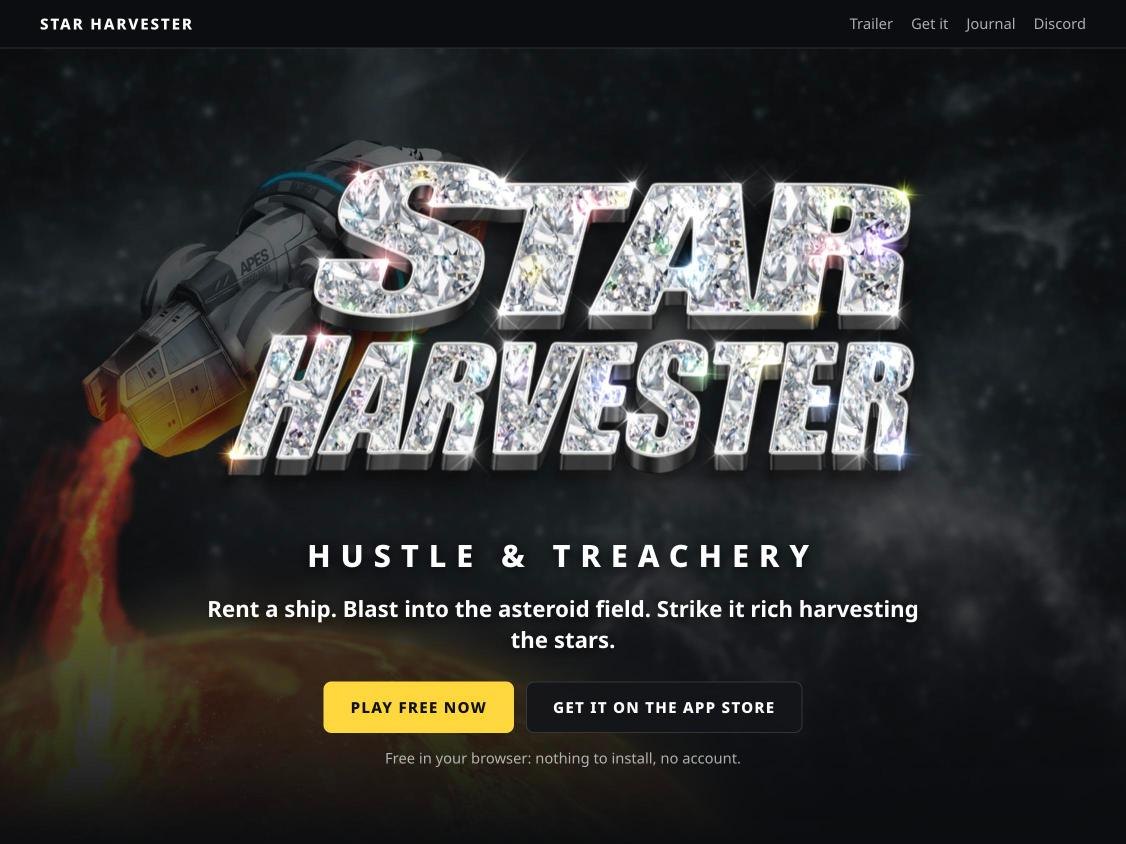
The page opens on the title art and the tagline, then one line of what you do: Rent a ship. Blast into the asteroid field. Strike it rich harvesting the stars. The first button plays the game right there in the browser, free, with nothing to install and no account. The type, the panels and the yellow are the game’s own, lifted from its interface, so the moment you click through, nothing changes but the fact that you are now playing.
Under the buttons, the page plays the trailer. It only promises one when the file is there, and the site’s build checks for it.
Everywhere Star Harvester is is drawn from a single data file: the browser, the App Store, Steam, Google Play, the Microsoft Store and the Snap Store, each with the platforms it covers. A store with an address is a link. A store without one says soon and links nowhere. When a store opens, one line changes and the whole page follows, so the page can never send a player to a door that is not open yet.
Below the stores, four panels lay out the game with a real screen from each part of it (rent a ship and compete, accidents happen, exploit the bureaucracy, two ways to win), and the studio’s journal sits underneath. Every pull request builds the site with the same Hugo version that deploys it, then checks the result: every store is on the page, the free-to-play link is there, and so is the trailer.
The share card is the game’s own start screen, so a link to starharvester.com looks like the game wherever it is pasted.
Look at the logo
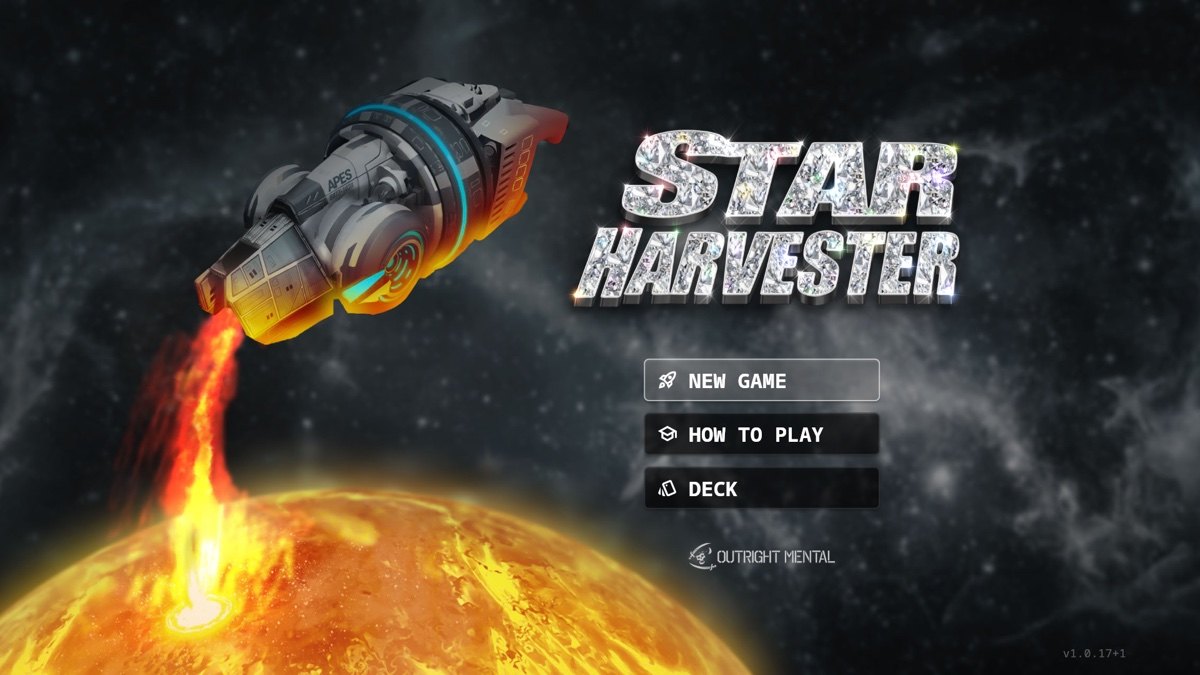
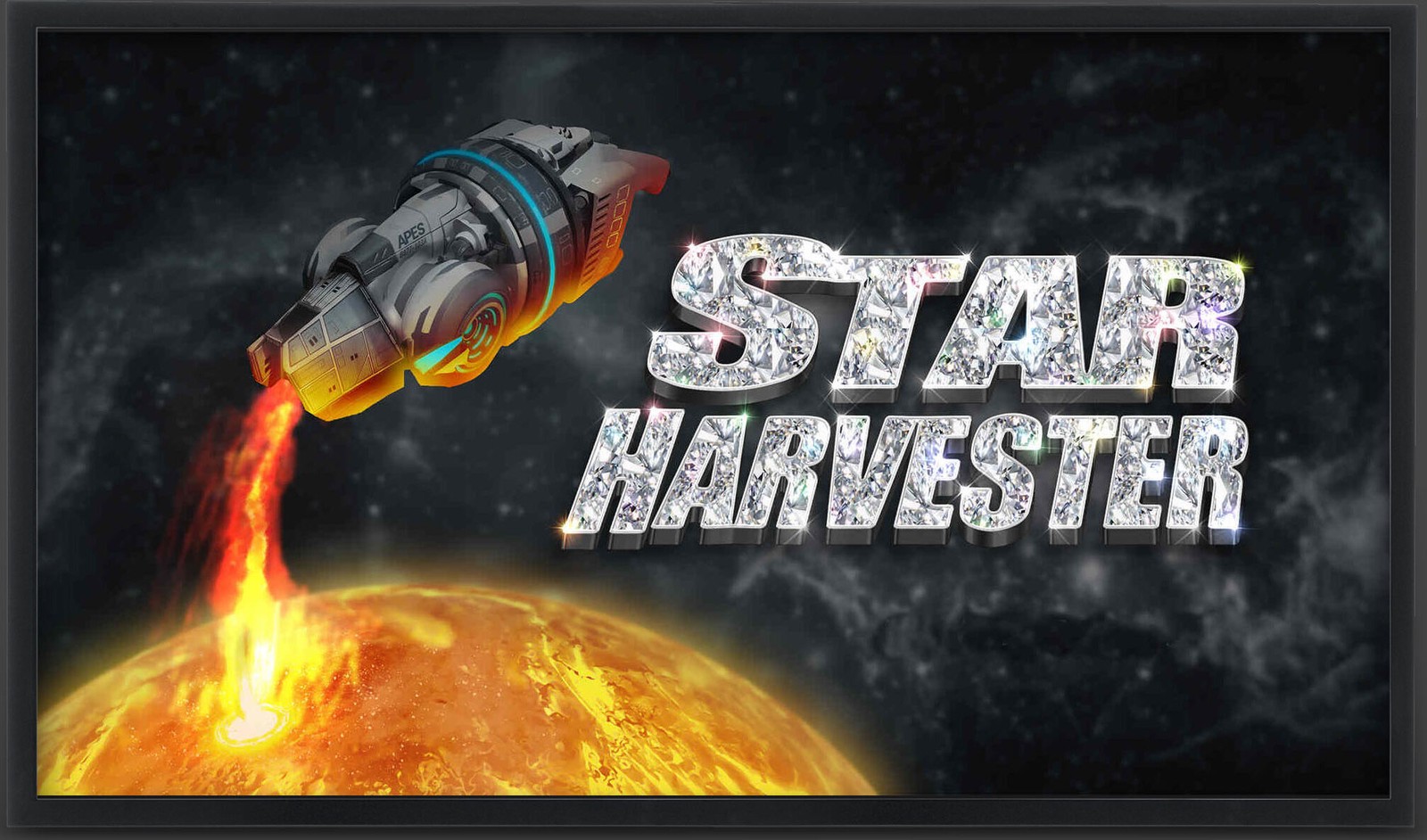
The title art sets STAR HARVESTER in chrome letters encrusted with diamonds, over an A.P.E.S.-liveried mining ship hauling a plume of fire off a molten planet. Nothing about it is modest. Out here the stars are money, so the logotype wears the haul: loud, fancy and dripping in the product.
Inside A.P.E.S.
Star Harvester is one of two games set in the same sky. A.P.E.S. is the corporation that owns it, and a product in its own right: the company’s front door is a working one, at apescorporation.com, where a license (a call sign, two colors and a rig) is issued to anyone who asks. Its position statement on rigs reads like the setup to this game: operators may not own one, because ownership is a liability, and the Corporation has assumed it on the operator’s behalf, at no charge beyond the rental, the fees, the deposit and the damage schedule.
Fever Tilt is the other game: the arcade cabinet on the station walkway, under the poster that reads HARVEST THE STARS WITH US! It started under this banner, too. Before it was Fever Tilt it was Blockbusters, released on starharvester.com in August 2025 as an arcade-speed taste of Star Harvester’s sabotage for the Noisebridge 1v1 Coffee Table, and it grew into the studio’s flagship.
The faces belong to the universe as well: the three champions you choose between at the start of every game were painted into one frame by Storam, personnel files and all.
Release log
29 December 2024: the first release, a board game for the web, Android, iOS and macOS. The journal entry.
16 August 2025: Blockbusters, the arcade cut that became Fever Tilt. The journal entry.
November 2026: the game it is now: champions with their own decks, a rival that changes plans every turn, thirty rounds and two ways to win. One release ships it to the browser, the App Store and every store after them, and records the trailer on the way out.
Next: Steam, for Windows, macOS, Linux and Steam Deck. Development runs in the open on Discord.
Our manifesto promises mechanics that expose choice rather than hide it. An asymmetrical game is that promise at full strength: when the game admits the field is tilted, every choice you make on it is real, including the choice to tilt it further.
Box score
- The field: a 12 × 12 asteroid field, resources scattered at random, a home exit each
- Champions: Van Sacke, Reyes and Dudakov, each with their own stats and deck; the rival flies another
- Win: 1,000 coin or 300 liability; thirty rounds at most, then the higher score
- The rival: a computer opponent that re-chooses its plan every turn (harvest, liability, defense, endgame)
- The trailer: 34 seconds at 1080p, recorded by the game itself, and again with every release
- Play: free in any browser and on the App Store for iPhone, iPad and Mac; Steam next
- Proof: starharvester.com · zero.starharvester.com · App Store · the trailer
Rent a ship. Strike it rich. Accidents happen.