

IAR-76
Integrated Assault Rifle, Model 76, 2001
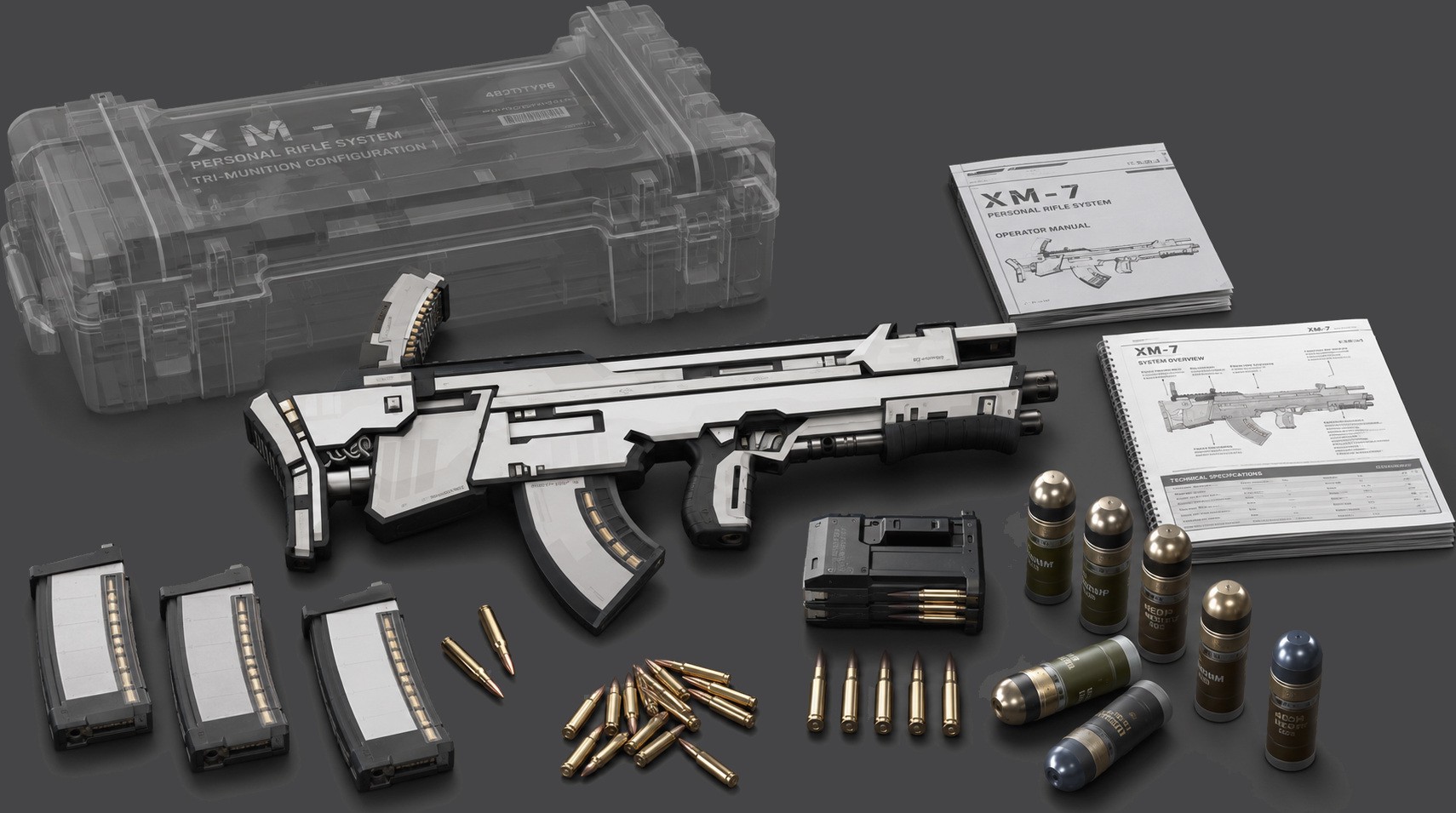
A science-fiction concept weapon combining three different munitions into a single combat platform — rendered not as a hero prop on a pedestal, but as the manufacturer would photograph it: the full kit, unboxed on the padded bench. Transit crate, operator manual, spiral-bound system overview open to the technical specifications, magazines staged, rounds counted. In the fiction, the corporate catalog lists it as the XM-7 Personal Rifle System, Tri-Munition Configuration; in the field, where it earned the name, it’s the IAR-76.
The conceit of the spread is that the experts who designed the product laid it out themselves — and it shows in the loadout logic.
Three munitions, one platform
6.5 Creedmoor — precision. Loaded top-down, bullpup again, all the way at the rear — because that barrel needs to be the longest in the system. Stripper clips in the kit, staged next to their loading gate.
40mm grenades — up front. Pump-action, bottom-fed tube magazine accepting variable shell lengths. Six shells in the spread, three patterns, because the tube doesn't care.
Sights — none. See below.
The absent reticle
Look closely: there is no optic on the rail and no iron sights on the barrel. The IAR-76 interfaces with the operator’s onboard cybernetic HUD, which carries the targeting for all three munitions — so switching from 7.62 suppression to a 6.5 precision shot to a 40mm arc is a software transition, not a hardware one. The weapon’s designers moved the most failure-prone component of any rifle — the part where a human aligns three points in space under stress — into the operator’s head, and the industrial design got cleaner for it.
That’s the satire, quietly: a future where the premium feature of a weapon is that you are the accessory it integrates with.
Craft notes
The spread runs wide, 16:9, with the transit crate ghosted at half opacity behind the subjects — present for provenance, faint enough to keep the bench honest. The rifle is rendered realistically, inferred as a true 3-D object from the original concept illustration; the manuals are the tell that this is worldbuilding rather than gun-catalog cosplay. Nobody prints an operator manual for a prop.
Unapologetic specificity, per the manifesto — the same discipline as any good game-design document: the clean spec, and the messy truth it was distilled from. If the fiction can’t survive a parts list, it isn’t a fiction worth shipping.
Concept development in the same universe: A.P.E.S. Champions and Star Harvester.