

Peep “Manipulative Language”
Writing & Illustration, 2013
- Role
- Writer & illustrator
- Target
- Show, mechanically, how a hedged news paragraph can convict a subject its sentences claim to exonerate
- Constraints
- October 2013 · self-directed · the argument has to be demonstrable rather than asserted — the proof is a strikethrough anyone can perform on the original text themselves
- Force fielded
- Nick Charney Kaye — writing and illustration
- Time-to-dispatch
- Published October 2013, days after the World Series game it examines; re-signed and re-vectorized under the Outright Mental stencil years later
- Result
- An essay that isolates the technique — sentence-final emphasis, weaponized into garden-path form — and the illustration Fooled Us that draws the mechanism as a single breath. The source article is still live and still does it
- Principal
- Outright Mental (self-directed — published media criticism)
- Business Insider the article under examination, still liveSource ›
- 3 sentences, one paragraph, one techniqueSource ›
- 2013 → today one drawing, two identitiesArchival · 2013
A media-criticism piece from October 2013 — the essay and its illustration, “Fooled Us,” restored together as originally published. A curator’s note follows.
An article on the popular website Business Insider claims to set the record straight about rumors of cheating at the World Series — the green smudge in Jon Lester’s glove, Game 1, Red Sox over the Cardinals. But manipulative language allows the writer to secretly reinforce a different message in our mind — and here’s how it’s done.
The article ends with this inconclusive paragraph:
We will probably never know if Lester was cheating during the World Series. At the very least there is reason to be suspicious. However, there is also reason to doubt he was up to no good.
It’s possible to manipulate a reader by taking advantage of how our brains work when reading. Scientists in the field of psycholinguistics believe that we rely on the end of each sentence to grasp its outcome.
Here’s the same paragraph, with only the end of each sentence:
We will probably never know ifLester was cheating during the World Series.At the very leastthere is reason to be suspicious.However, there is also reason to doubthe was up to no good.
These three statements (perhaps unintentionally) are weaponized versions of garden path sentences — far more conclusive, and incriminating, than they first appear.
Step 2 — put the accusation at the end. Sentence-final position is where comprehension lands, so that is what gets kept.
Step 3 — repeat, three times, in one paragraph. Each sentence hedges at the front and convicts at the back.
Step 4 — let the reader do the rest. Nothing false has been printed. Nothing fair has been communicated.
The test: delete every clause before the last one and read what remains. That is the message the paragraph actually delivered.
Curator’s note
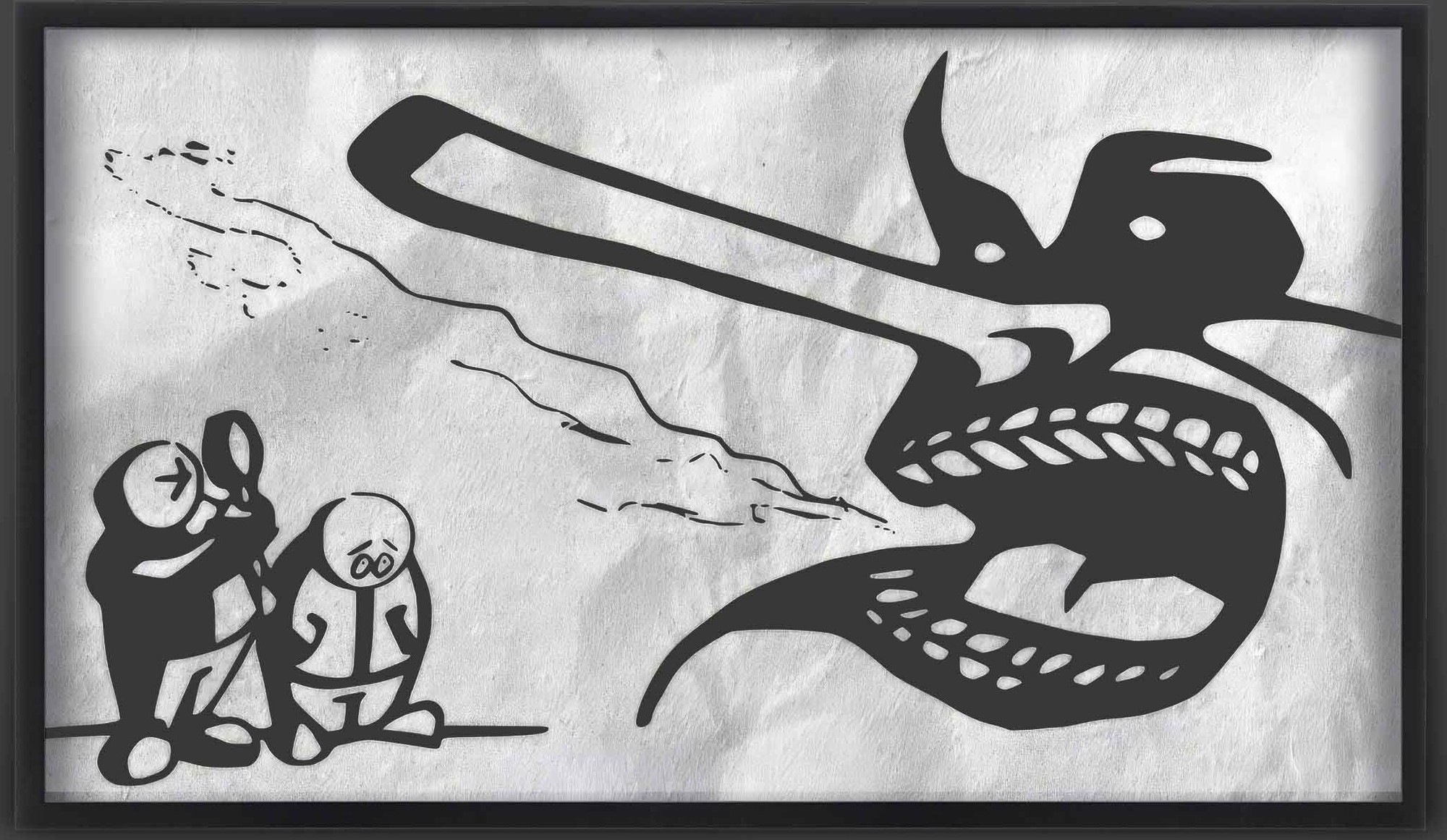
The illustration. “Fooled Us”: a long-nosed liar breathes wavy smoke over two small onlookers. One peers through a magnifying glass — and his eye has been replaced by a directed arrow, his gaze literally steered. The other kneels, wide-eyed, already convinced. The whole psycholinguistic mechanism, drawn as a single breath.
The provenance. The original 2013 publication ran under the earlier Nick Kaye identity — white background, NICKKAYE.COM, the NCK monogram in the corner:
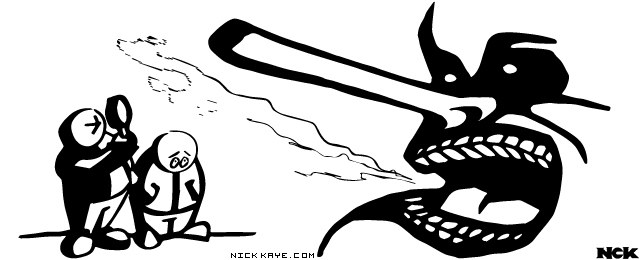
It was later re-signed under the Outright Mental stencil on crumpled paper, and re-vectorized in Inkscape — one drawing, carried across a decade and two identities. The date matters too: this page corrects the record to October 2013, when Game 1 actually happened.
We question narratives — including our own, says the manifesto. This piece is that principle pointed at journalism’s most innocent-looking trick: the sentence that technically hedges and psychologically convicts. Peep the language. It’s still everywhere.
Proof: the Business Insider article — still live, still ending its sentences that way. Run the strikethrough yourself · garden path sentences · psycholinguistics, language comprehension.