


Wetware
Interactive Practice for the Body’s Chemical Messengers, 2026
Inside every one of us, the same messengers are talking. Wetware is the studio’s free site for learning thirteen of them, the chemical messengers that shape waking and sleep, stress and recovery, pain, wanting and closeness, a few minutes a day. Its front door asks what is bothering a visitor before it teaches anything, and every mechanism it teaches ends in three things: what they could change, how sure the evidence is, and how they could find out for themselves.
- Role
- Design & engineering
- Target
- A few minutes a day for learning how thirteen chemical messengers shape sleep, stress, pain, drive and closeness, where every mechanism ends in what a visitor could change, how sure the evidence is, and a fair way to find out for themselves
- Constraints
- 2026 · the handbook's sentences shown word for word and set apart from the site's own text, each kind with its own sources · every lever graded for evidence and carrying its safety notes, each grade marked proposed until a named reviewer signs · no accounts and no advertising, and nothing a visitor records ever leaves their browser · education and general wellness, never diagnosis or treatment, and never advice to start, stop or change a medicine · readable at landscape, portrait and phone widths · and the limit stated on the page: it claims to improve understanding, not wellbeing
- Force fielded
- Nick Charney Kaye: design and engineering; a static site with no backend and no account, where everything a visitor records stays in their own browser
- Time-to-dispatch
- Live at wetware.outright.io, its permanent address since 21 October 2026; version 2.1.0, its evidence last checked 10 November 2026
- Result
- A free site built on a short handbook of 13 messengers in 12 sections and its 36 cited sources: twelve hands-on rooms; seven paths of two to three weeks, for sleep, stress, pain, drive and flatness, closeness, energy, and claims and headlines; 16 levers graded from A to X, with 139 studies and guidelines behind them; three maps of the whole system (how the thirteen relate, where they act in the body, and a 24-hour day); a notebook for one self-experiment at a time; a six-minute myth check to take before and after; and a two-minute check-in for the moment a visitor is in
- Principal
- Outright Mental (self-directed)
No molecule is a feeling
The idea under every page comes from the handbook the site is built on: what a messenger does depends on which receptor, where, how much, when, and what the circuit’s history has done. A list of thirteen messengers invites thirteen labels (“the happy chemical,” “the love hormone”); Wetware is built so the labels cannot survive a visit.
Twelve rooms make that idea something to handle. Each is a small model with no units, a place where the same messenger acts differently, and a visitor predicts before the answer shows. In Same Key, Different Rooms, one acetylcholine contracts a muscle and slows the heart. In Two Routes, the body gears up for a demand by a fast route and a slower one, then comes back down. On the Claim Bench, a headline meets five questions: what was measured, where, when, in whom, and to what outcome.
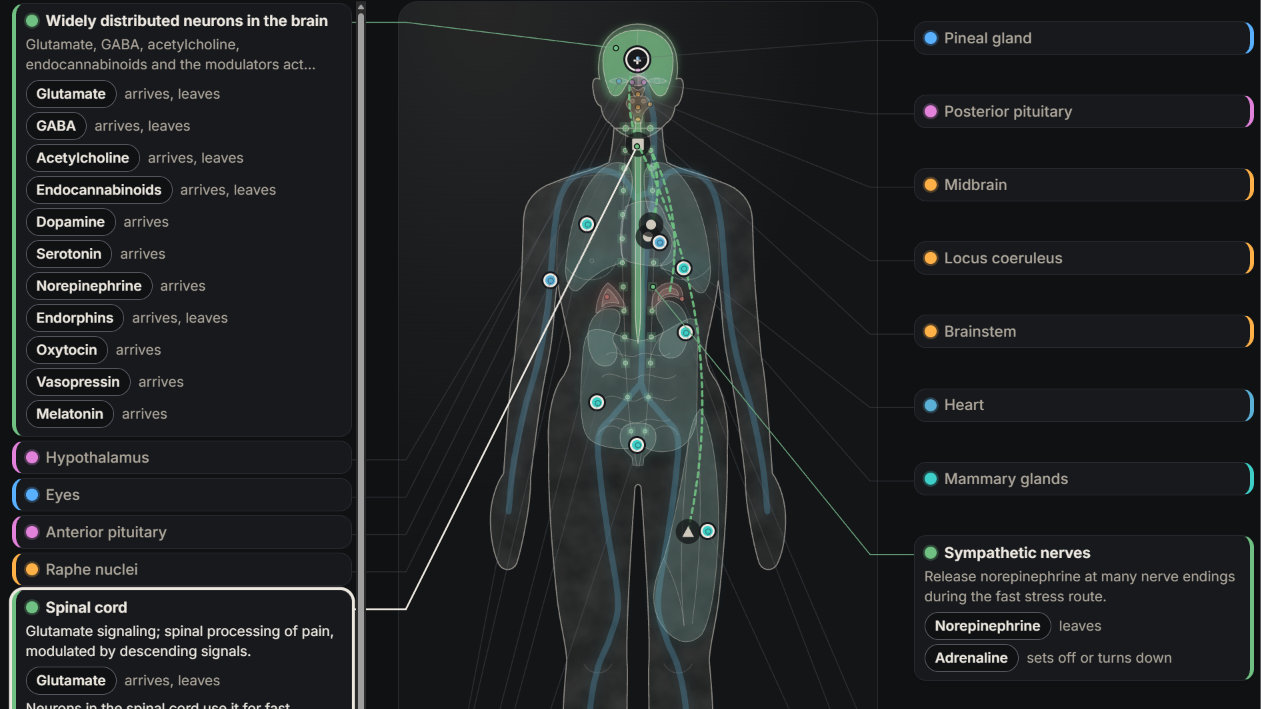
Three maps show the whole system at once. The map draws how the thirteen relate in twelve pathways, from daily rhythm and stress to reward and sleep; every line on it is a relationship the handbook states, with its sentences one tap away. The body map shows where each messenger is made and where it acts, organ by organ. My Day lays a typical day on a 24-hour ring, with illustrative curves for sleep pressure and the body clock.
A few minutes a day
Wetware runs as a short loop: learn a little in a room, predict before you see the answer, notice something in your own day, try one small lever for a week, and look back. Today puts the loop in one place, about four minutes long. Seven paths give it a beginning, a middle and an end, one for each reason a visitor arrives: sleep, stress, pain, drive and flatness, closeness, energy, and “happy chemical” headlines. Each is nine or ten short steps over two to three weeks, and each says when it is worth seeing someone. Missed days cost nothing.
Two tools hold the visitor’s own side of it. How am I? takes two minutes for the moment they are in: a word that fits (wired, flat, foggy, hopeful), two dials for energy and tension where neither end is better, what may be contributing, and one small thing to try. The notebook takes a check-in in about twenty seconds and runs one experiment at a time: a baseline, a week of change, and an honest before-and-after with its caveats.
Every lever shows its grade
Sixteen levers are the things a visitor can change, and none of them works by turning a chemical up or down; each is about something a person can notice, like sleep, energy, mood or what they can do. Every one carries an evidence grade, who it is for, who should talk to someone first, its safety notes, its sources, and the smallest way to try it for a week. A fixed wake time grades A. Precursor supplements sold as “boosters” grade X: not a lever at all, but a case for the Claim Bench. Melatonin supplements are not a self-experiment, and the card says to talk to a pharmacist or clinician first.
Grades follow the reasoning of GRADE, the method guideline panels use, and each badge has its own shape as well as its letter, so it never rests on color. The wording follows the evidence too: settled physiology “is,” mainstream but incomplete “is thought to,” early findings “some studies suggest,” and work done only in animals or in the lab says so, in words and with an icon.
The site keeps two kinds of authority apart on every page. Sentences set in serif are the handbook’s own words, unchanged. Everything in the plain type is the site’s own and cites its own list, the 139 studies and guidelines behind the levers, kept apart from the handbook’s 36 sources. Notes beside each handbook section say where the science stands now: settled, contested, or changed. It is the rule the studio’s other research instrument runs on: if a claim has no source, it doesn’t ship.
Honest about what knowing can do
The site’s honest limits begin with a finding against itself: knowing how your body works rarely changes how your days go on its own, and the research says so. For chronic low back pain, education about pain alone moved a 10-point scale by less than a point, and only in the short term. For insomnia, an analysis of 241 trials found sleep hygiene education was not an essential part of cognitive behavioral therapy for insomnia. In one experiment, explaining low mood as a chemical imbalance left people more pessimistic about getting better. So every mechanism on the site ends in what can change, and on what timescale, and Wetware claims only what it can: better understanding, and the ability to run small, safe experiments on your own days. It does not promise to improve anyone’s wellbeing.
It is as plain about itself. No one has independently reviewed Wetware yet, and it names no reviewer until one has reviewed and signed; until then every grade is marked proposed, and the page lists who the review needs, a neuroscientist or physiologist and a clinician. It measures nothing about a visitor unless they choose to: a six-minute myth check of twelve everyday situations, with no score, to take again after a path; one question about what they know they can try; and, if they want it, the WHO-5 every two weeks. All of it stays in their browser, because there is no server that could receive it. There are no accounts and no advertising. It is education and general wellness, never diagnosis or treatment, it never asks anyone to start, stop or change a medicine, and every page links to where to get help now.
Proof: Wetware · the seven paths · the twelve rooms · the sixteen levers · the map · the body map · the handbook · the sources · honest limits