

Conversation Simulator Open Source
Free to Build, Fair to Buy, 2026
Conversation Simulator is free software with a price tag, and the two facts are not in tension. This page is the license model: what’s free, what the Steam build charges for, and why the split holds.
The split
The engine is Apache-2.0 and the four official scenario packs are CC BY 4.0: clone it, build it, run it, modify it, redistribute it — for nothing, forever. The paid Steam version is the same software, packaged: signed, notarized, auto-updating, Steam Deck–ready. You’re not paying to unlock the product; you’re paying for the convenience of not building it yourself — and so the work can continue.
The promise that makes the model trustworthy is the one-way valve: nothing free today ever moves behind that price. The paid content is only ever more — premium expansion packs on Steam, never a feature clawed back from the commons. A FOSS project that quietly walls off its core has spent its credibility; this one’s credibility is the product, so the valve is load-bearing.
Proprietary data on a non-proprietary core
The deeper argument for the license is who it unlocks. Because the engine is Apache-2.0 and runs entirely on local hardware, a private organization can put it to work on things it could never send to a vendor: a hospital can commission scenario packs built on its own case material, a firm can wire the engine to the in-house model it already trusts, a government agency can drill personnel on classified-adjacent situations — all on hardware they control, against data and models that remain entirely theirs. No license negotiation, no data-processing agreement, no per-seat meter. Permission was granted in the license, in advance, to everyone.
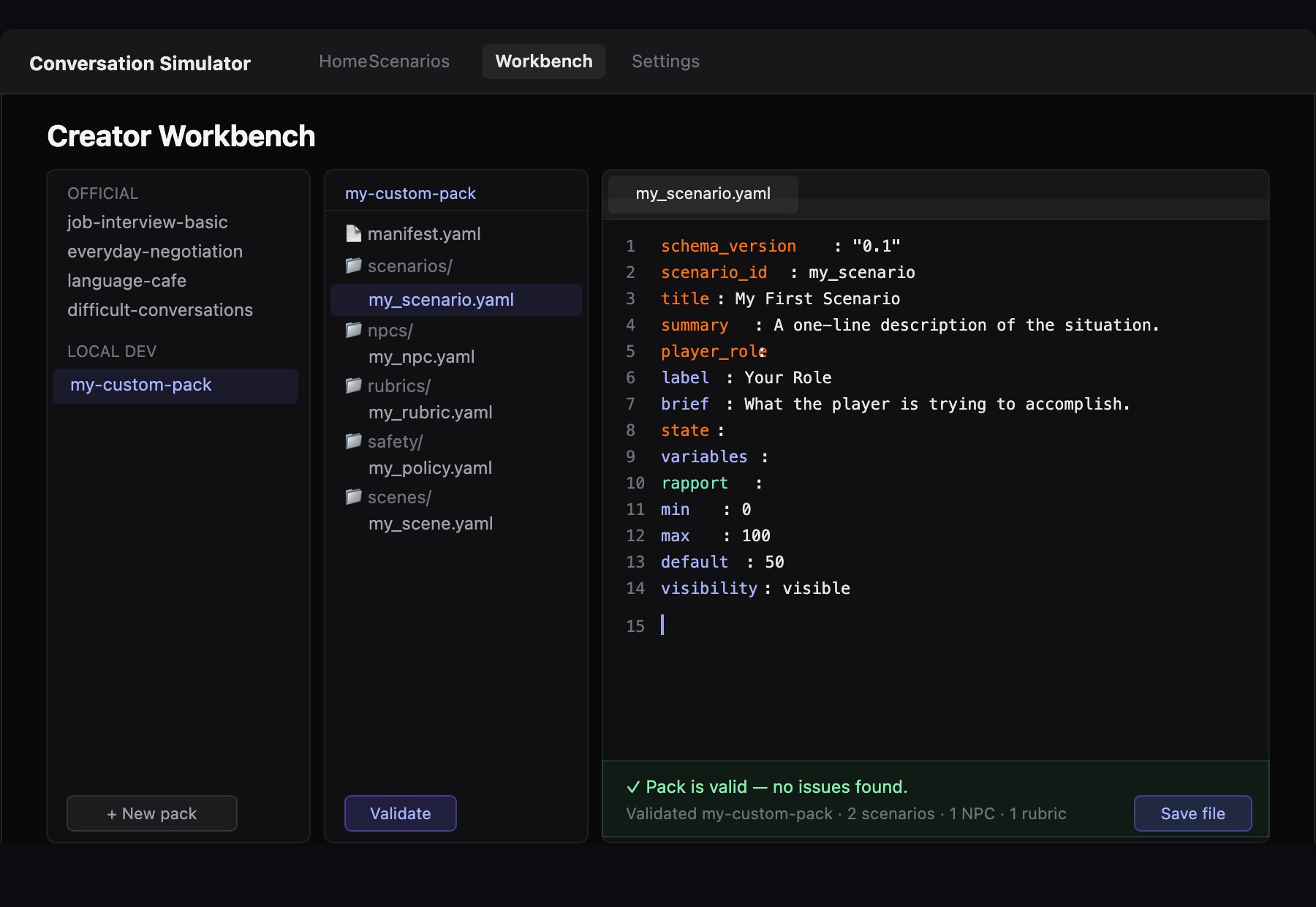
And the core stays non-proprietary while they do it. Private deployments don’t fork the commons; engine improvements land in the open, and the Creator Workbench validates anyone’s scenarios against the same published quality bar as the official packs. The two immutable safety rules travel with the engine into every deployment — community and commissioned packs can make safety stricter, never looser.
Where the money meets the mission
The commercial layer sits on top of the open core, in exactly two places: the Steam build for individuals who value convenience, and commissioned scenario packs and pilots for institutions that want their exact practice need authored, safety-reviewed, and handed over as YAML they own. Both fund the same free engine. Neither compromises it. If the studio disappeared tomorrow, every user — paid or not — still holds working software and the source it came from.
Proof: source (Apache-2.0) · docs · download / Steam · official packs — CC BY 4.0