

Transformation Lab
Execution Practice, 2026
- Role
- Principal Investigator
- Target
- An execution practice that turns operational opportunity into measurable business impact — and refuses to count anything it cannot measure
- Constraints
- 2026 · adoption is a stage, not a hope; measurement is a stage, not a retrospective · every case defines its baseline, target outcome and proof method before implementation begins · no case advances until its current stage genuinely clears its exit criteria
- Force fielded
- Nick Charney Kaye — Principal Investigator, independent and cross-functional
- Time-to-dispatch
- Standing practice, portfolio always visible — weekly working sessions, monthly portfolio review, quarterly business-impact review with finance in the room
- Result
- An eight-stage lifecycle running a live public portfolio of enterprise cases, each with a named stakeholder, a function or P&L, an honest stage and a target outcome — published at nickcharneykaye.com/cases. Because a target is not an outcome, each case publishes its achieved number only once it clears measurement
- Principal
- Outright Mental / the operator's independent execution practice
An independent execution practice led by Principal Investigator Nick Charney Kaye: it turns operational opportunity into measurable business impact, and refuses to count anything it can’t measure. Every engagement runs the same lifecycle, reports at three levels, and lives in a public portfolio.
The Lab documents work as cases — so this page is one. The Lab, filed through its own intake.
2. Problem / pain: innovation theater — slide decks without adoption, adoption without measurement
3. Owner / function: Principal Investigator · independent, cross-functional
4. What success would look like: solutions that are useful, measurable, adopted, scalable
5. Timing or deadline: standing practice · portfolio always visible
Before the lifecycle, one honest question: is this your door? Route yourself in a glance.
The lifecycle, applied
Each case moves through eight stages — Intake, Discovery, Prioritization, Design, Build/Implement, Adoption, Measurement, Scale/Close — and never advances until its current stage is genuinely complete, per explicit exit criteria. Adoption is a stage, not a hope: a solution only counts if people use it. Measurement is a stage, not a retrospective: every case defines its baseline, target outcome, and how impact will be proven before implementation begins.
Impact reads at three levels — the case (hours saved, errors reduced, conversion lifted), the program (related cases compounding), and the P&L (what business outcome actually changed) — with every case naming a primary value type: time, cost, revenue, risk, or experience, and whether the value is direct, influenced, or enabling.
The portfolio is the proof
The Lab keeps its work visible — every case with a stakeholder, a function or P&L, a stage, and a target outcome:
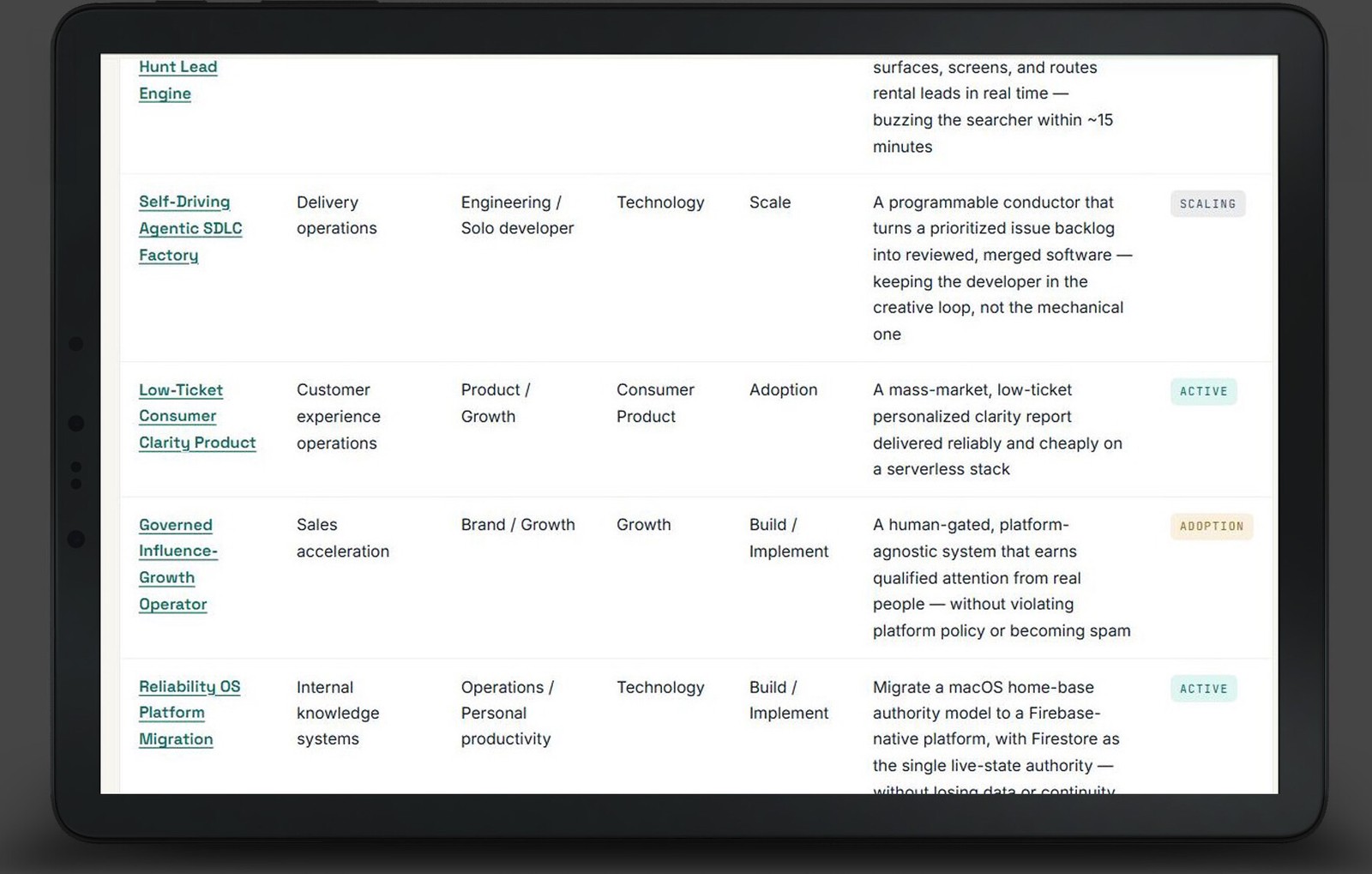
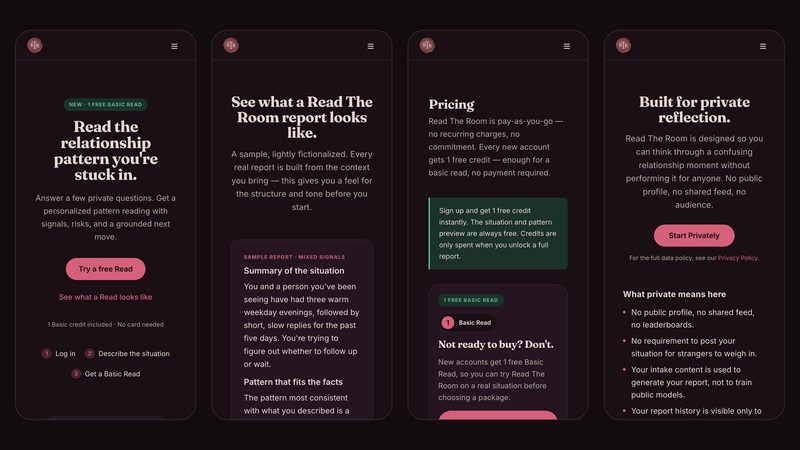
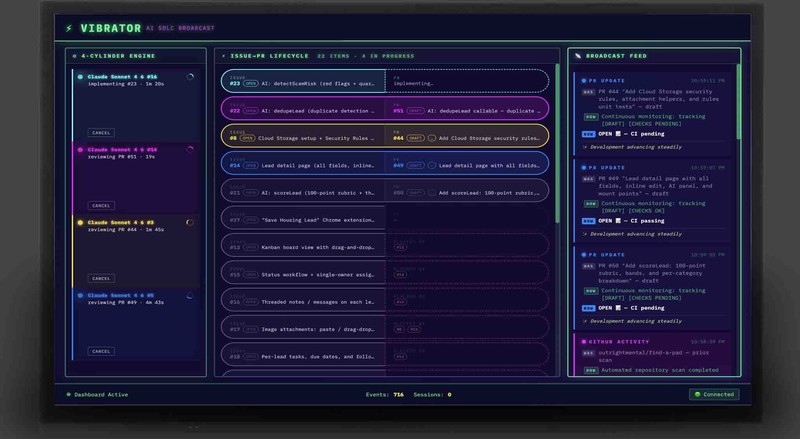
Look at the rows. Self-Driving Agentic SDLC Factory — scaling — is Yoke, run as a measured delivery-operations case. Low-Ticket Consumer Clarity Product — active — is Read The Room, measured as customer-experience operations. Alongside them: an AI-augmented SDLC for legacy migration at enterprise scale, on-call schedule automation already in adoption, an always-on apartment-hunt lead engine, a governed influence-growth operator with a human-in-the-loop gate on every action, and a reliability OS platform migration. One person’s projects, accounted for like a portfolio company — stakeholder named, stage honest, outcome measured.
Because a target is not an outcome, the Lab holds one hard rule for this portfolio: as each case clears its measurement stage, it publishes the case’s baseline and its achieved number — not the projection it was sold on — building toward four cases that carry achieved outcomes, and this page links them the moment those values go live.
How every engagement runs
Business problem first — technology only matters when it produces a better business outcome. Practical over theoretical. Reusable when possible. Stakeholders stay close: the Lab doesn’t disappear into a build cycle, and governance is deliberately lightweight — weekly working sessions, monthly portfolio review, quarterly business-impact review with finance in the room. Small wins are expected to compound; not every case needs to be massive.
This is the studio’s manifesto wearing a business suit. Measurable or it does not count is presence over avoidance applied to work: no dashboard theater, no unfalsifiable wins. Acceptance is not passivity — measure honestly, then scale what works and close what doesn’t. And it usually starts with one sincere sentence: “this process takes too long.”
Proof: nickcharneykaye.com · method — lifecycle, measurement, governance · the living case records · engage