

Wetware Connections
Interactive Map of the Body’s Chemical Messengers, 2026
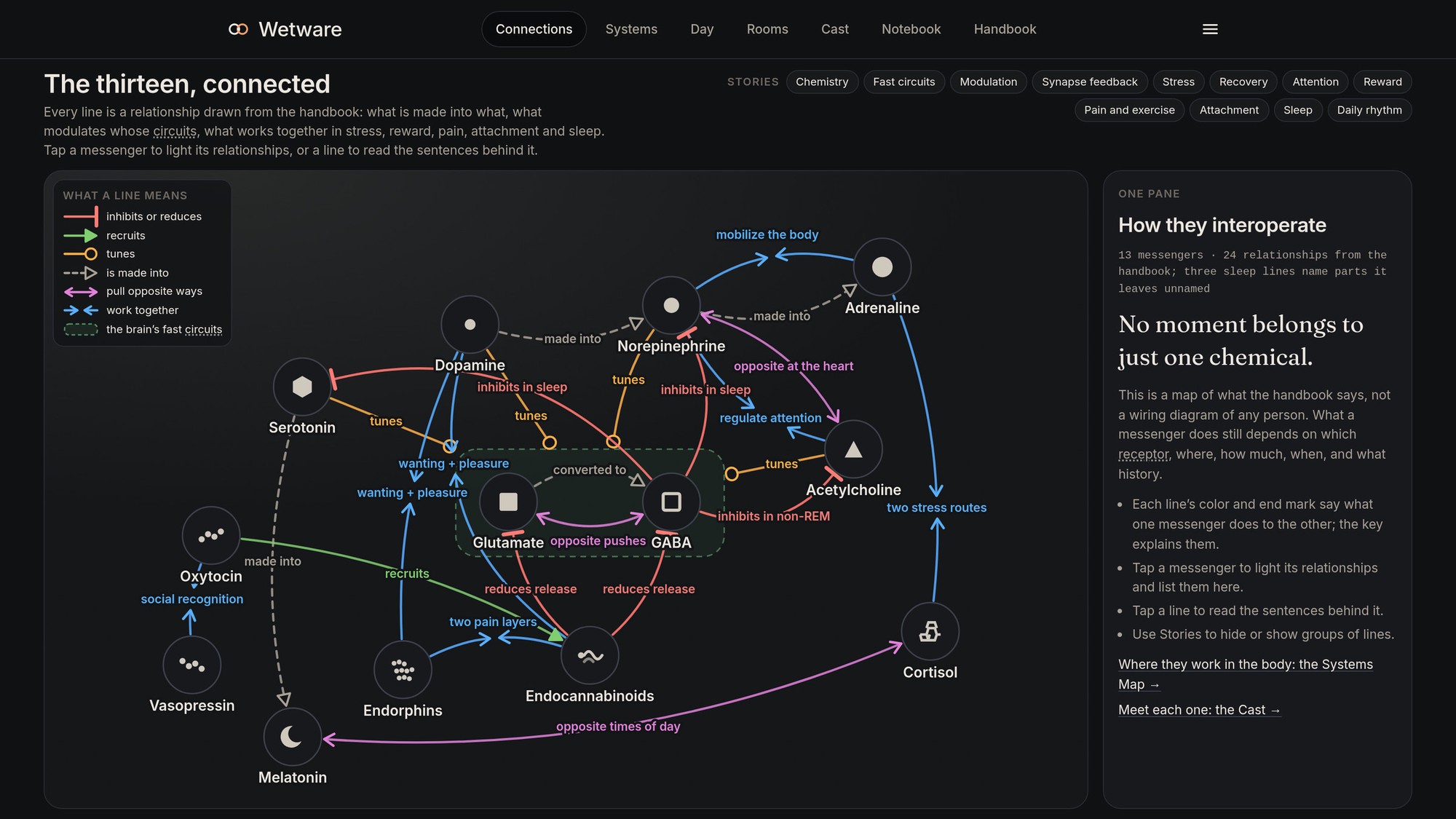
Thirteen chemical messengers on one map, and every line between them is a sentence from the handbook. Wetware is the studio’s interactive practice for learning the messengers that shape waking and sleep, stress and recovery, pain, wanting and closeness. Connections is its view of the whole cast at once: not where each messenger lives, but how the thirteen work together.
- Role
- Design & engineering
- Target
- One view of how the thirteen messengers in a sourced handbook work together, drawn so that every line on it is something the handbook actually says
- Constraints
- 2026 · every relationship is a handbook statement, its sentences shown word for word and checked by the build · messengers stay neutral gray glyphs, and color belongs to what a line does · no strengths, doses or time course · readable at landscape, portrait and phone widths · and the limit stated on the page: a map of what the handbook says, not a wiring diagram of any person
- Force fielded
- Nick Charney Kaye—design and engineering; a static site with no backend and no account, where a visitor's progress stays in their own browser
- Time-to-dispatch
- Live at wetware.outright.io/#/connections, its permanent address since 21 October 2026
- Result
- A graph of 13 messengers and 24 relationships in 12 stories, from chemistry and the fast circuits to stress, reward, sleep and daily rhythm. Each line's effect (inhibits or reduces, recruits, tunes, is made into, pull opposite ways, work together) sets its color and end mark. Tap a messenger and its relationships light up, phrased from its side; tap a line and the panel shows the handbook sentences behind it, their section, and the room on the site that explores them
- Principal
- Outright Mental (self-directed)
Every line is a statement
The graph draws 24 relationships in 12 stories: chemistry (what is made into what), the brain’s fast circuits, modulation, feedback across the synapse, stress, recovery, attention, reward, pain and exercise, attachment, sleep, and daily rhythm. None of them is invented for the picture. Each line carries the handbook’s own sentences, word for word, with the section they come from and the room on the site that explores them, and the site does not deploy if one of those sentences drifts from its source. It is the rule the studio’s other research instrument runs on: if a claim has no source, it doesn’t ship.
A line also says what it does. Its effect sets the color and the end mark: a flat bar inhibits or reduces, an arrow recruits, an open circle tunes, and a hollow arrow on a dashed line is chemistry. Where the handbook gives two messengers a shared job without saying how one affects the other, two arrows meet at the label that names the job; where two pull opposite ways, the arrows point away from the middle. The messengers themselves stay neutral gray glyphs, so color always belongs to a relationship and never to a chemical.
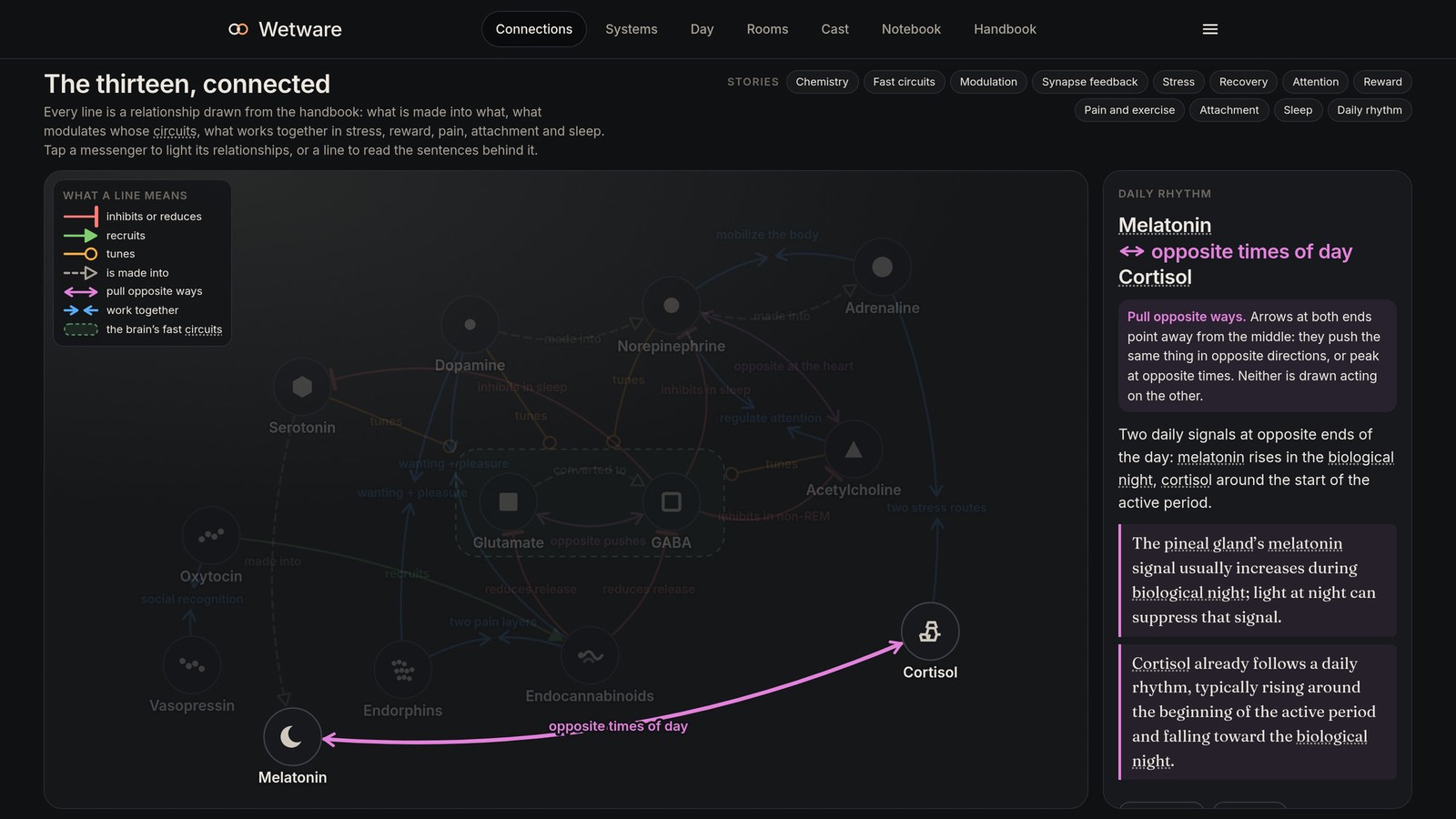
Twelve plain toggles hide or show each story, so sleep, stress or reward can be read alone. Select a messenger and the panel lists every relationship it has, phrased from its side of the line: GABA is converted from glutamate, tuned by dopamine, and inhibits in sleep both norepinephrine and serotonin.
A map, not a wiring diagram
The limit is printed on the page itself: this is a map of what the handbook says, not a wiring diagram of any person. It has no strengths, doses or time course, and what a messenger does still depends on which receptor, where, how much, when, and what history. Where a line reaches past the handbook’s words, its panel says so. The handbook says sleep circuits inhibit “parts of the waking system” without naming them, and the three sleep lines that name those parts are marked as going further than the text.
No moment belongs to just one chemical.
That sentence from the handbook sits beside the graph, and it is the reason the graph exists. A list of thirteen messengers invites thirteen labels (“the love hormone,” “the happy chemical”); a map of how they act on one another makes the labels impossible to keep.
The rest of the practice
Connections is one of several ways into Wetware. The Systems Map labels every part of the body with the messengers that arrive there and leave. Fourteen rooms are hands-on models a visitor can drag, build and break to watch what changes. The handbook and its 36 sources are always one tap away. The site is free, asks for no sign-up, keeps a visitor’s progress in their own browser, and is an illustration of established roles, not a measurement and not medical advice.
Proof: the Connections graph · the Systems Map · the fourteen rooms · the handbook · the 36 sources